Dental Deep Cleaning
Dental deep cleaning involves more than just a simple prophy cleaning done at regular dental visits. If you have serious periodontal (gum) problems, a deep cleaning is often needed as a way to fight this type of gum infection.
Periodontal diseases are infections of the gum and bone areas of the mouth. Highly recognized as a greatly progressive disorder, periodontal disease is triggered by preventable factors like plaque build-up, tobacco use, certain medications and stress, as well as unpreventable factors such as systematic disease and fluctuating hormone levels during puberty, pregnancy or menopause. Research proves up to 30% of the population may be genetically susceptible to gum disease. If left untreated, periodontal disease can progress and lead to tooth loss.
Periodontal disease affects 75% of adults over 35 years of age and is responsible for approximately 70% of all adult tooth loss. In addition, research has proven that up to 30% of the population may be genetically susceptible to gum disease. Since symptoms of periodontal disease oftentimes are unnoticeable, people never realize their mouth is under bacterial attack until diagnosed by a dentist.
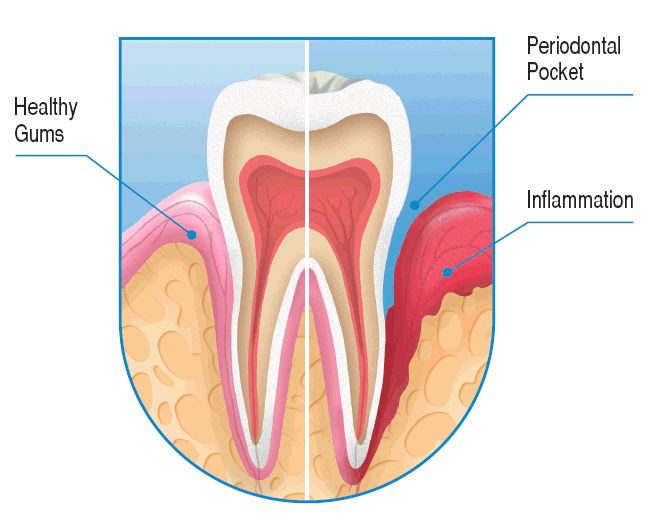
The primary cause of periodontal disease is an adhesive colorless layer of plaque accumulating onto the surface of teeth. If it is not removed, in addition to causing gum irritation, the plaque will harden and turn into scale (tartar or calculus), a rough, porous substance not easily removable with brushing. The plaque will continue to release toxins, breaking down the natural fibers which hold the gums to the teeth, permitting even more bacteria and toxins to invade. The end result is infection and the destruction of the gum tissues which support our teeth. The gums begin separating from the tooth, creating a "pocket".
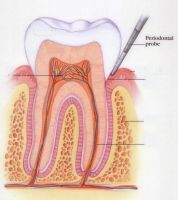 |
During your checkup, the dentist uses a periodontal probe (see left photo), to gently measure the depth of the spaces between your teeth and gums. At the edge of the gumline, healthy gum tissue forms a very shallow, V-shaped groove (called a sulcus) between the tooth and gums. The normal depth should be 3 millimeters or less. Anything greater than 3mm would be considered prone to gum disease. Fortunately, gum disease can be treated in the early stages with a dental deep cleaning in the form of a scaling and root planning procedure. |
Scaling is the process of the periodontist dentist or dental hygienist removing plaque and tartar from the tooth surfaces. The type of scaling used is dependent upon the amount of plaque and tartar that is found on the tooth surface. The dentist or hygienist will usually perform the procedure by hand. But, with advances made in dentistry, the use of electronic scalers, such as a cavitron has been introduced to the deep dental cleaning process. Cavitrons use sound waves to remove tartar and can help to decrease the amount of time it takes to perform a dental deep cleaning. However, ultrasonic scalers can only remove at least half of tartar buildup, so to achieve the best results, both the electric and manual scaling are often done in combination during the dental visit. It is important to note that the use of ultrasonic scaling should not be performed on individuals who wear pacemakers. This is because the ultrasonic sound can interfere with the function of the pacemaker.
Root planning is the process of cleaning the gum pockets (located beneath the gum line) in order to stop gum problems from advancing. When gums are inflammed, the gum pockets become deeper and lose its connection to the bone. The deeper the pocket, the easier it is for plaque deposits to become trapped and worsen the condition of the gums. Root planning involves the dentist or hygienist inserting the pointy front of handle scalers into the pockets to clean out the plaque. The tooths root surfaces are then smoothed or planed to allow the gum tissue to heal and make additional plaque accumulation in this area difficult. Because root planning is a little more invasive that a regular prophy cleaning, the use of local anesthesia is sometimes used to reduce any discomfort. Also, depending on the extent of the problem, this procedure can take several dental visits. The dentist may also recommend, prescribe, or administer medications to help control the infection and to facilitate the healing process.
The amount of time needed for a dental deep cleaning depends on such factors as the amount of plaque involved and your overall gingival health. Obviously, the more tartar and plaque you have, the more appointments you will need. In moderate cases of gum disease, the cleaning should take about 25 to 30 minutes. Treatment often depends on how far the condition progressed and how well the body responds to treatment. At your follow-up visit, the gums will be checked for healing and to see if there has been a decrease in the pocket size. If the pockets continue to exceed 3mm, additional measures may need to be undertaken. In certain cases, periodontal surgery may be recommended when non-surgical treatments like dental deep cleanings, are found to be ineffective.


|
|
|

Advertising

